Monday, September 9, 2013

Expedite


A new EXPEDITE artistamp has been issued by Cascadia Artpost. The original design is a pen-and-ink drawing in a 6 3/16-inch (15.7 mm) square format reduced to fit a 1-inch by 1-inch perforation. Curved lines set against a universe of blue circles symbolize communication in the Eternal Network.


Ex Postal Facto - February 2014


The Ex Postal Facto Conference is coming to San Francisco, U.S.A. in February 2014! See the details below:


Friday, July 19, 2013

MAIL ART CALL !


MAIL ART CALL :
KEEP THE POST OFFICE PUBLIC !

Cascadia Artpost invites a correspondance (to borrow a Ray Johnson term) in the form of artistamps, postcards, or other mail art with the theme "Keep the Post Office Public." The theme relates to current attempts in the U.S. to downsize the postal workforce, discontinue Saturday delivery of mail to residences, close post offices, close distribution centers, and add at least one more day to the delivery time for domestic mail.

Cascadia Artpost will publish printed documentation in the form of a brochure with distribution to all contributors. Send your work by September 30, 2013 to:
 

POSTAL CALL

Cascadia Artpost

4609 Briggs Drive SE, #304

Olympia, WA 98501-5515 U.S.A.

Wednesday, June 26, 2013

dada


During a trip to Scotland and the United Kingdom in September 2012, one evening we were walking down a street in the Borders city of Carlisle in search of an Italian restaurant that we had spotted earlier that day. Imagine our surprise to happen upon a nearby business (a hair salon as it turned out) identified by its prominent sign, "dada." The photo we took becomes the subject of an artistamp created by Cascadia Artpost. In the world of mail art, "dada" has one meaning, but if you find yourself one day in the city of Carlisle and need your hair cut, here is an alternative.

Music Bar


A revised MP3 music bar has been added to this blog for your listening pleasure. You can find it across the top of the blog page.

The initial selections include "Across the Divide" and "Ballad for Trayvon Martin," jazz compositions by Anthony Branker and the group "Word Play" (Ralph Bowen on tenor saxophone, Andy Hunter on trombone, Eli Asher on trumpel and flugelhorn, Jim Ridl on piano, Kenny Davis on bass, and Donald Edwards on drums) from the CD Uppity (Origin Records, recorded in Brooklyn, New York, USA in June 2012). Also on the list: "Notas" and "Queremos Paz" from the Argentine/French group Gotan Project, and "One More Mile" by Cascadian saxophonist Brent Jensen.

Tuesday, June 11, 2013

Sixty Six Memories

A sheet of sixty-six artistamps titled "Sixty Six Memories" recalls memories from a month-long trip to Latvia, Ireland, and Denmark in June-July 2005. Selected original photos from the journey comprise the small-format sheet, designed to be separated into four minisheets for use on postcards mailed in connection with the release of the stamps. The sheet and postcards became a submittal to Eberhard Janke's 2013 mail-art call Ray of Light.

Provided below is a key to the subject of each artistamp, reading from top left across eleven stamps in six rows:

1. Section of wall in the Christiania district, Copenhagen, Denmark

2. "Mind the Clouds" political graffiti on metal container, Christiania district, Copenhagen, Denmark

3. Looking toward the Burren region of County Clare from waterfront beach, Galway, Ireland

4. Sign over the entrance to a store, Riga, Latvia

5. Garden view through wall, Skjoldenaesholm estate, near Jystrup, Denmark

6. The man on the street, Old Town, Riga, Latvia

7. Map of rapid transit plan for Copenhagen, Danish Tram Museum (Sporvejsmuseet Skjoldenaesholm), near Jystrup, Denmark

8. Detail, display at Danish Tram Museum (Sporvejsmuseet Skjoldenaesholm), near Jystrup, Denmark

9. Seaweed-covered coastal rocks on beach east of Giant's Causeway National Park, Northern Ireland

10. Narrow-gauge track, Giant's Causeway & Bushmills tourist railway, Northern Ireland

11. Traffic signs at road end, Christiania waterfront, Copenhagen, Denmark

12. Gates to city tram depot, Liepaja, Latvia

13. Bark of tree trunk observed during a walk in Liepaja, Latvia

14. Wall graffiti in Old Town, Riga, Latvia

15. Stormy sky over Skjoldenaesholm estate, near Jystrup, Denmark

16. Friendly cow in pasture along Coast Trail east of Giant's Causeway National Park, Northern Ireland

17. Hillside flowers, Coast Trail east of Giant's Causeway National Park, Northern Ireland

18. Red-haired lass and drummer on pedestrian street in town center, Galway, Ireland

19. A friend (Elizabeth) wandering the corn maze at Skjoldenaesholm estate, near Jystrup, Denmark

20. Paving stones near the Royal Palace, Copenhagen, Denmark

21. Exterior decoration over doorway, Riga, Latvia

22. "Stop Bush!" posters near the Arbejermuseet, Copenhagen, Denmark

23. Friends Elizabeth and Ted in the dungeon,  Skjoldenaesholm estate, near Jystrup, Denmark

24. Mural along canal, Copenhagen, Denmark

25. Bus stop art, Riga, Latvia

26. Rollercoaster at Tivoli Garden, Copenhagen, Denmark

27. Colorful cottage and shed along alley, Kenmare, Ireland

28. Trail markers, Coast Trail east of Giant's Causeway National Park, Northern Ireland

29. Abandoned apartment block at the former Soviet naval station of Karosta, north of Liepaja, Latvia

30. Boats in harbor, Portrush, Northern Ireland

31. Abandoned building, former Soviet naval station of Karosta, north of Liepaja, Latvia

32. Post box at the Zasulauka train station, neighborhood west of the Daugava River, Riga, Latvia

33. Detail of windmills from miniature village outside the municipal museum, Copenhagen, Denmark

34. Behind a recreation vehicle on a narrow highway on the way to Kenmare, Ireland

35. Street sign on dwelling along Rozu Iela, Liepaja, Latvia

36. Thistles along country walk outside Galway, Ireland

37. Wedding couple posing on a Saturday afternoon, beach east of Portrush, Northern Ireland

38. Flower box at apartment building window, Liepaja, Latvia

39. Stile crossing along Coast Trail east of Giant's Causeway National Park, Northern Ireland

40. Warning sign about rockfalls and bus traffic, Giant's Causeway National Park, Northern Ireland

41. Orange cottage door, Galway, Ireland

42. Sheep seeking shade next to rental car, parking area near Mamean gate, Maumturk Mountains, Connemerra, County Galway, Ireland

43. "Khrushchev apartment" block, Liepaja, Latvia

44. Poster detail next to bicycle parking at train station, Jystrup, Denmark

45. Volcanic stone formation, Giant's Causeway, Northern Ireland

46. Waterfall reflection along canal, Galway, Ireland

47. Afternoon street crowd in town center, Galway, Ireland

48. Exterior building ornamentation detail of screaming face, Riga, Latvia

49. Abandoned cottage, southern coast west of Kenmare, Ireland

50. Nasturtium flower garden along wall, Ennis, Ireland

51. Transit street supervisor on a busy Saturday at the bus stop outside Trinity College, Dublin, Ireland

52. Rural mountain pass highway, Dingle Peninsula, Ireland

53. Tower of the Riga Cathedral built in 1211, Riga, Latvia

54. Flags on apartment window sill near the Royal Palace, Co
 
penhagen, Denmark

55. Stormy sky above Humlebaek railway station, northern Zealand, Denmark

56. Residential structure ruin, Riga, Latvia

57. Beach path to the Baltic Sea, Liepaja, Latvia

58. Couple lying in the sun next to canal, Galway, Ireland

59. Trail gate, Mamean ("The Pass of the Birds"), Maumturk Mountains, Connemerra, County Galway, Ireland

60. Sand dollar on beach near Dunseverick Harbour, Coast Trail east of Giant's Causeway National Park, Northern Ireland

61. Overhead rail catenary and electrical insulators outside Humlebaek railway station, northern Zealand, Denmark

62. Friend Ted allocating strawberry pastries at sidewalk bakery, Roskilde, Denmark

63. Flower display near railway station, Roskilde, Denmark

64. Ornamentation detail above doorway, Riga, Latvia

65. Post office, Kenmare, Ireland

66. Solstice sunset at 11:00 p.m. from Akmens Tilts (bridge) over the Daugava River, Riga, Latvia


A New Logo for Cascadia Artpost

Cascadia Artpost has introduced a new logo for use where typography of full lettering would be too distracting or intrusive to the artistamp design. The logo consists of the letter "C" surrounded by a half-size "A" and "P" in the font Chantal.

Thursday, May 9, 2013

Mayworks Exhibition: The Artist at Work / Self Portrait


The Mayworks 2013 Mail Art Exhibition curated by Ed Varney (May 1-26, 2013 at the Nanaimo Art Gallery in Nanaimo, Canada) invited mail artists to submit a postcard on the theme "The Artist At Work / Self Portrait." Cascadia Artpost has created an artistamp to accompany its submittal to the exhibition. The photo used for the stamp shows the artist at a hotel desk in Amsterdam, The Netherlands, preparing a mailing to correspondents while on European vacation in September 2012.

Sunday, February 17, 2013

Spring 2013


Cascadia Artpost heralds the coming of spring in the Northern Hemisphere with an artistamp illustrating the flowering plant Dianthus chinensis, commonly known as "China Pink." Dianthus chinensis is a flowering herbaceous perennial native to China, Korea, Mongolia, and southeastern Russia. Attractive bicolored white, pink, and red flowers that are 3-4 cm. in diameter bloom primarily from April to June, but blooming can be extended through the summer into the fall by regular pruning of wilted flowers. Favoring dry to medium soil, the plant grows in a clump between 15 and 30 cm. in diameter and attracts hummingbirds.


The Yes Men


The Yes Men are jammers of corporate culture. Cultural jamming is a set of tactics used to expose assumptions behind commercial and political culture, and can take the form of refigured logos, fake websites, and image manipulation to make ironic or satirical statements. The object is to disrupt unconscious thought processes and promote alternatives to global corporate capitalism.

Jacques Servin and Igor Vamos, working under the aliases of Andy Bichlbaum and Mike Bonanno respectively,  have created a network of supporters to impersonate entities they dislike, a practice they call "identity correction." By catching these powerful entities off-guard, the Yes Men and their supporters expose corporations and organizations to public scrutiny with the intent of showing how they work and figuring out how to control them. The Yes Men strategize what would cause their target to lose control and act stupidly, capitalize on their target's reaction, and write news releases.

The Yes Men have produced two documentary films about their exploits. The Yes Men (2003) records their invitation to speak at a conference in Austria sponsored by the World Trade Organization. In The Yes Men Save The World (2009), they target neoliberal think tanks, the creators of Captain Euro, climate-threatening corporations, and Dow Chemical for the environmental and human disaster it caused in Bhopal, India. Currently The Yes Men are working on a new film project.


Cascadia Artpost has saluted The Yes Men with a set of five artistamps and a popup brochure. The designs of the artistamps modify scenes from publicity photos. Modifications included scanning the photos through thin tissue paper, colorizing selected portions of the scenes and adding facial details (Cascadia Artpost's own identity correction!), rescanning, and editing in Photoshop Elements.

For the latest activities of The Yes Men, see their website: http://theyesmen.org/

Friday, December 7, 2012

POSTAARPEX


Cascadia Artpost created a sheet of artistamps following the Artistamp Artists Reunion & Philatelic EXposition held on 10 November 2012 as its POSTAARPEX issue. POSTAARPEX features photos taken by AARPEX participants Jennie Hinchcliff, Jack Lattemann, and Kathleen McHugh to record the interactions of artists and the public at AARPEX. Illustrated above are six stamps from the sheet.

E. F. Higgins III Birthday Commemorative


Cascadia Artpost honored the birthday of E.F. Higgins III, long-time creator of artistamps, by releasing a multicolored sheet displaying the silhouette of a "wingnut." Higgins' birthday on 10 November coincided with the all-day event AARPEX (Artistamp Artists Reunion & Philatelic Exposition) held in Seattle, Washington USA. Cascadia Artpost presented Higgins with a framed sheet of the birthday artistamps at a dinner with AARPEX participants that evening.  Higgins has used the wingnut as an icon for his Doo Da Postage Works. Making hundreds of stamps since the 1970's, Higgins lives in New York City with summer stints in Elberta, Michigan. He can be found on the internet at http://efhigginsiii.com/index.html .

AARPEX


The Artistamp Artists Reunion & Philatelic EXposition was held on 10 November 2012 at University House in Seattle, Washington USA. Organized by Seattle artist C. T. Chew, AARPEX featured U.S. and Canadian creators of artistamps and mail art and was open to the public. Participant artists included Chew (Triangle Post), E. F. Higgins III (Doo Da Post), Anna Banana, Ed Varney, Dame Mailarta, Jas Felter, Steve Smith (Art Gone Postal), Harley, Jennie Hinchcliff (Red Letter Day), Robby Rudine (Dogfish of Tui Tui Post), Jack Lattemann (Cascadia Artpost), Dominique Johns (Bugpost), Teesha Moore, Bill Ritchie, Kathleen McHugh (Eagle Island Post), Dixion, Marvin Johnson (bufo), and Jere Smith. Jas Felter created a special "fireworks" artistamp and poster used in AARPEX publicity. On 11 November, AARPEX participants and friends participated in the grand opening of the Museum of Artistamps, hosted by Tui Tui Post.

Cascadia Artpost produced this slightly reformatted version of an AARPEX commemorative created for a composite sheet of stamps produced jointly by AARPEX participants and printed by Triangle Post. Sheets of the Cascadia Artpost AARPEX commemorative were specially delivered to AARPEX participants on the morning of the event.

Monday, August 6, 2012

Ambrose Bierce


Ambrose Bierce was one of the leading journalists and commentators known in the United States in the late 19th and early 20th centuries. A contemporary of the more well-known Mark Twain, Bierce today is most popularly associated with The Devil's Dictionary (first published in 1906 as The Cynic's Word Book), a collection of satirical definitions and witty aphorisms that originally appeared in his newspaper columns.

As a young man Bierce served as a Union Army lieutenant in the American Civil War. His wartime experiences greatly affected him as he published a number of short stories and volumes of poetry. Best known among the short stories are "An Occurrence at Owl Creek Bridge" and "Chickamauga." After mustering out of the army, Bierce settled in San Francisco and began writing for a number of publications. After moving to London in 1872 where he wrote magazine articles and his first book, Bierce moved back to San Francisco in 1875 and became a regular columnist in William Randolph Hearst's San Francisco Examiner newspaper.

Although some label Bierce a cold cynic and curmudgeon, one can discover a "courageous despair" behind Bierce's biting satire. Bierce detested hypocrisy, stupidity, and villainy in human affairs. We prefer to view Bierce as a disappointed idealist who delighted in, according to H. L. Mencken, "the spectacle of human cowardice and folly." The Ohio University English professor Jack Matthews wrote in 2004, "Behind all the bitterness and the thunderous nay-saying, one can detect a profound interest in, and fascination with, the human adventure."

Bierce spoke out against imperialism and the excesses of corporate capitalism. In 1896 Hearst sent Bierce to Washington DC to expose the attempt by Collis Huntington on behalf of the Central Pacific and Union Pacific railroads to persuade the U.S. Congress without public hearings to excuse the railroads from repaying large loans from the U.S. Treasury totaling $130 million (about $3 billion in today's money). Bierce's coverage and biting commentaries led to the defeat of this legislation.

Bierce was not without shortcomings. He was a misogynist who opposed women's right to vote, and shared the prejudices of his day about people of color. However, Bierce cared not for the hustling nature of American politics and culture. He commented on American politics and character in his "Prattle" column appearing in the satire magazine Wasp on May 27, 1881:

"Certain unannealed idiots whom I have the advantage of knowing have been pleased to be offended by my remarks last week on the essential dishonesty of the American character. Well, I don't say these remarks were not offensive; I only say they were true. It is one of my failings that I do not know any better than to write the truth. Somebody, however, might say this in my favor; that I have never insulted the intelligence of my readers by flattering them. Most journalists think it pays to do so; I think it does not. The moral difference between them and me, in this matter, is not a wide one, clearly, and I regard it as a highly creditable example of humility that I consent to be no better than they are, but only wiser."

After divorce and the death of his ex-wife, Bierce moved back to Washington DC but at age 71 was restless and decided to travel to Mexico to write about the Mexican Revolution. His last letter from the city of Chihuahua to a friend dated 26 December 1913, closed with, "As to me, I leave here tomorrow for an unknown destination."

According to an essay by Glenn Willeford ("Ambrose Bierce, 'The Old Gringo': Fact, Fiction and Fantasy"), one report had claimed Bierce to have been seen in Ojinaga, a village just west of the Mexico-U.S. border and Presidio, Texas, prior to the assault on the federal garrison in Ojinaga on January 10, 1914. However, research on oral histories by the late priest Fr. James Lienert, M.S.F. suggested that Bierce had ventured southeast to the village of Sierra Mojada, where he was arrested by forces loyal to General Huerta, a rival of Pancho Villa, accused of spying for Villa, and executed by firing squad in early 1914. Lienert erected at his own expense a tombstone to Bierce in the cemetery of Sierra Mojada in 2004. Nonetheless, the evidence on Bierce's ultimate fate is inconclusive. The disappearance of Ambrose Bierce remains a mystery.

The Mexican novelist Carlos Fuentes wrote a 1985 novel, The Old Gringo, speculating about Bierce's crossing the border into Mexico during the Mexican Revolution and subsequent disappearance. A film with the same title starring Gregory Peck and Jane Fonda followed in 1989.

For more information about the life and writings of Ambrose Bierce, we recommend the following two internet websites:
http://www.ambrosebierce.org/     The Ambrose Bierce Project
http://www.donswaim.com/     The Ambrose Bierce Site

Bierces most well-known and most quoted work, The Devil's Dictionary, was first published in 1906 under the title The Cynic's Word Book. Bierce did not like the title chosen by the publisher and republished the collection in 1909 under his preferred title The Devil's Dictionary. The most complete collection of Bierce's definitions drawn from all sources is The Unabridged Devil's Dictionary edited by David E. Schultz and S. J. Joshi (Athens, GA and London: University of Georgia Press, 2000). Bierce's short stories have been collected in The Complete Short Stories of Ambrose Bierce (Stilwell, KS: Digireads.com Publishing, 2008). A modern look at Bierce's commentaries on English usage is Jan Freeman's Ambrose Bierce's Write It Right, The Celebrated Cynic's Language Peeves Deciphered, Appraised, and Annotated for 21st-Century Readers (New York: Walker and Company, 2009).

To recognize Ambrose Bierce, Cascadia Artpost has published an artist book, set of playing cards, and two artistamps in Summer 2012.


Zunino


Cascadia Artpost recognizes Mike Zunino, the #1 baseball amateur draft pick (#3 overall) of the Seattle Mariners professional baseball team. The artistamp features a photo of Zunino at bat taken on July 27, 2012 at a minor league Class A Everett AquaSox game. Zunino currently plays as a catcher for Everett.

Update - August 2012:
The Seattle Mariners promoted Zunino to the Double-A Jackson, TN Generals of the Southern League, where he has been playing as catcher and designated hitter. Though 26 August, Zunino has hit for a .430 average. Scouts predict that he will be playing major league baseball by the second half of the 2013 season.

Tuesday, March 27, 2012

FluXus Identity


Artistamp sheet and postcard prepared for the "Sign and Language" exhibition in Oldeberkoop, The Netherlands, 28 July to 26 August 2012.

Sunday, January 22, 2012

FAVORITE BOOKS


What are your favorite books? In conjunction with the Flux Libris artistamp release, Cascadia Artpost presents a set of twelve artistamps representing more favorite books discovered over the past several years. Despite the advent of new electronic media, we think books will remain a significant medium of human communication.
Here are brief descriptions of the twelve favorite books, in order from left to right on the artistamp sheet:
Books, Boxes & Wraps by Marilyn Webberley and JoAn Forsyth (1998) is a handy and comprehensive resource of book arts skills and projects that we discovered in a book binding class last fall. With many hand-drawn illustrations, this book covers book binding tools, leaves and scrolls, accordion bindings, sewn bindings, single signature bindings, multiple signature bindings, folders and wraps, and how to make boxes and cases.
The Museum of Innocence by Orhan Pamuk (2010) is a novel of romance set in the author's Istanbul, Turkey. Kemal, the main protagonist and narrator, is engaged to be married to Sibel, but when he meets Füsun, a beautiful shopgirl and distant relation, he becomes enthralled. Over the next eight years, he becomes a compulsive collector of objects that chronicle his relationship with Füsun, a museum that maps both society and his heart. The author even appears as a character in his own novel (page 124)!
The Map as Art, Contemporary Arts Explore Cartography by Katherine Harmon (2009), is a beautifully illustrated collection over over 350 map-related artistic visions that are as much explorations of the interior mind as they are of exterior landscapes. In-depth essays explore the works of Joyce Kozloff, Landon Mackenzie, Ingrid Calame, Guillermo Kuitca, and Maya Lin.
Railroaded, The Transcontinentals and the Making of Modern America by the Stanford University history professor Richard White (2011), presents a new interpretation of the impacts of the transcontinental railroads as the first corporate behemoths in the United States. White dissects industrialization in the so-called Gilded Age, the financial schemes that supported the expansion of rail, early organized labor movements of the American working class, and how the capitalist moguls in the second half of the 19th century and early 20th century initiated new forms of corruption on Wall Street and among politicians national and local to get their way. White makes unsettling comparisons with the troubles brought on by the financial sector in our own time.
The Lomholt Mail Art Archive edited by by Niels Peter Lomholt and Lene Aagaard Denhart (2011) is a large (640 pages) volume filled with color illustrations from Niels Momholt's extensive collection of works, letters, and personal encounters with mail artists from Al Ackerman to David Zack in 1971-85, works by the Lomholt Formular Press between 1975 and 1985, and documentation of Lomholt's video work between 1971 and 2006.
A Question of Values by cultural historian Morris Berman (2010) presents wide-ranging essays previously unpublished in the United States on American culture and politics, the human existential condition, and the notion of progress. Berman challenges readers to rethink the accepted mainstream of values and the American culture of material consumption, and argues that current problems are as much ethical as political. The essays are organized in four parts: Lament for America, Mind and Body, Progress True and False, and Quo Vadis. Their wide range is revealed by the titles, such as "To See Ourselves as We Are Seen," "The Black Hole of Bethesda," "Ways of Knowing," "The Hula Hoop Theory of History," "Tribal Consciousness and Enlightenment Tradition." Most of the essays were originally published in Spanish. Berman currently lives in Mexico.
Why America Failed, also by Morris Berman (2012), is intended as a post-mortem examination of the U.S. in decline as a world empire. Berman examines American culture from the time of the first English colonies to the present, and makes the case that the elements of the American "hustler" culture were present from the very beginning, guiding American expansion as a continental and then global empire and now American decline. He asserts that hustling, materialism, and the pursuit of individual gain without regard for impacts on others have been powerful forces that have overwhelming contravailing visions.
The Dictionary of Imaginary Places by Alberto Manguel and Gianni Guadalupi (2000) catalogs the imaginary places invented by literature. Like a literary travel guide, this book is a pleasure to browse, its descriptions enhanced by abundant illustrations of maps, structures, artifacts and other details of imaginary geography.
Good Mail Day, A Primer for Making Eye-Popping Postal Art, by Jennie Hinchcliff and Carolee Gilligan Wheeler (2009), is a colorfully illustrated guide to making mail art. Good Mail Day covers mail art etiquette, assembling a mail art kit for travel, how to make and illustrate envelopes, designing and reproducing artistamps, penmanship, finding correspondents with whom to exchange in the mail, developing one's "postal personality," and starting mail art projects. Included in the book are a list of resources, stickers, post cards, and an envelope template. This is a great resource and collection of ideas for those new to mail art as well as the seasoned mail art collaborator.
A Paradise Built in Hell, the Extraordinary Communities That Arise in Disaster, by Rebecca Solnit (2009), recounts examples of altruism, resourcefulness, generosity, and community-building that arise in the aftermath of disasters. Solnit is one of our favorite writers who consistently presents a vision of life that is less authoritarian and fearful, and more hopeful, collaborative, and local.
Every War Has Two Losers by the late Cascadian poet William Stafford (2003) is a less well known collection of daily writings from journals, essays, and poems on peace and war. A conscientious objector during World War II, Stafford believed that there were more options than simply fighting or running away. This volume is timeless in its relevance.
Fuel, Poems by Naomi Shihab Nye (1998), is one of the fine collections of poetry by this Palestinian American poet. Here is an example:
I Still Have Everything You Gave Me
It is dusty on the edges.
Slightly rotten.
I guard it without thinking.
Focus on it once a year
when I shake it out in the wind.
I do not ache.
I would not trade.

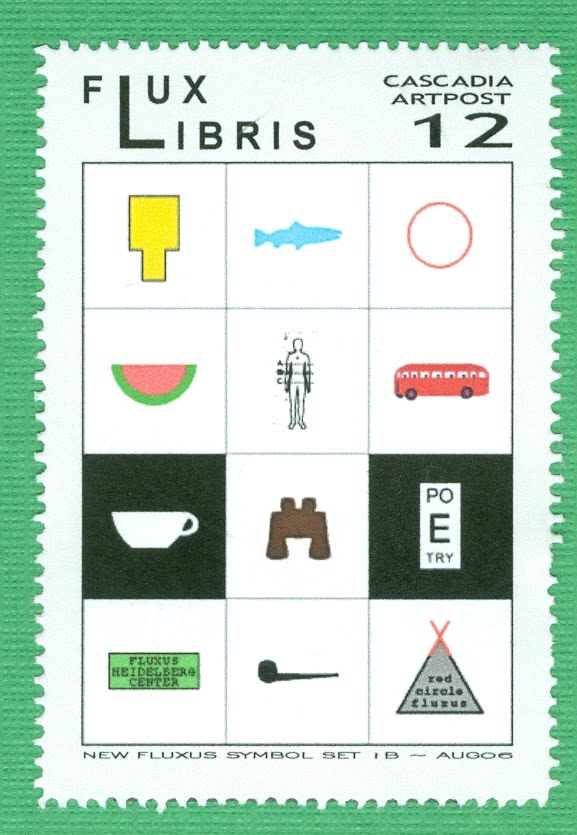
FLUX LIBRIS


The idea of Flux Libris began with a December 2011 letter enclosed along with a sheet of artistamps from Seattle artist Carl Chew, who invited Cascadia Artpost and other mail artists to produce a work for the "Ex Libris" exhibition of book plates at the Davidson Galleries in the Pioneer Square neighborhood of Seattle. The exhibition is showing during the month of January. Despite the short notice, we quickly designed an artistamp based on the New Fluxus Symbol Set 1-B as the subject to commemorate the gallery exhibition and more than 50 years of the Fluxus attitude.
New Fluxus Symbol Set 1-B first appeared on September 6, 2006 as "clip art for everyone" posted by Allen Bukoff on the Fluxlist Blog, which can be found here:
If you click on each image, a link will take you to the origin of the image.
A live performance on September 30, 2006 features Allen Bukoff who creates an artistamp sheet with rubber stamps printing each image of the New Fluxus Symbol Set 1-B, and can be found here:

NEW YEAR 2012


Cascadia Artpost welcomes the new year 2012 with an artistamp of suspended holiday balls against a stylized background of bluish dots that could be seen as snowflakes. The design is an update of last year's artistamp. We liked the design so much that we used it again.

May the year 2012 bring you good health, supportive and loving people in your life with whom to share and create, and new inspirations.

AÑO NUEVO 2012
Cascadia Artpost acoge con satisfacción el nuevo año 2012 con una artistamp
de las bolas de vacaciones suspendidas sobre un fondo estilizado de puntos azules
que se podía ver como los copos de nieve. El diseño es una actualización de artistamp del año pasado. Nos gustó el diseño tanto que se utiliza de nuevo.

De mayo del año 2012 traerá una buena salud, las personas de apoyo y
de amor en tu vida con quien compartir y crear, y nuevas inspiraciones.

ANO NOVO 2012
Cascadia Artpost saúda o novo ano 2012 com um artistamp de bolas de férias
suspensos contra um fundo estilizado de pontos azulados que poderia ser visto como flocos
de neve. O projeto é uma atualização de artistamp do ano passado. Gostamos do projeto
tanto que usamos-lo novamente.

Que o ano de 2012 lhe trazer boa saúde, pessoas de apoio e de amor em sua vida com
quem compartilhar e criar, e novas inspirações.

NOUVEL AN 2012
Cascadia Artpost se félicite de la nouvelle année 2012 avec une artistamp de boules
de vacances avec sursis contre un fond stylisé de points bleutés qui pourraient être considérés comme des flocons de neige.
Le design est une mise à jour de artistamp l'an dernier. Nous avons aimé le design autant que
nous l'avons utilisé à nouveau.

Que l'année 2012 vous apporter une bonne santé, les personnes de soutien et d'amour dans votre vie avec qui partager et de créer, et de nouvelles inspirations.

Yeni Yıl 2012
Cascadia Artpost, kartaneleri gibi görülebilir mavimsi nokta stilize
edilmiş bir arka plana karşı askıya tatil topları artistamp yeni yıl 2012 ağırlamaktadır.
Tasarım, geçen yılki artistamp bir güncelleme. Biz, o
kadar çok tekrar kullanılan tasarım sevdim.

2012 yılı size sağlık, hayatınızı paylaşmak ve oluşturmak için kiminle destekleyici ve
sevgi dolu bir insan ve yeni ilham getirebilir.

NEU JAHR 2012
Cascadia artpost begrüßt das neue Jahr 2012 mit einem Artistamp
suspendierter Urlaub Bälle gegen einen ansprechenden Hintergrund bläulichen Punkte,
die wie Schneeflocken zu sehen war. Das Design ist ein Update der letztjährigen Artistamp. Uns gefiel das Design so sehr, dass wir es wieder verwendet werden.

Möge das Jahr 2012 bringen Ihnen gute Gesundheit, unterstützende und liebevolle Menschen
in Ihrem Leben, mit denen zu teilen und zu schaffen und neue Inspirationen.

JAUNAIS GADS 2012
Cascadia Artpost atzinīgi vērtē jauno gadu 2012 ar artistamp suspendēto brīvdienu
bumbiņas pret stilizētu fona zilgani punkti, var uzskatīt par snowflakes.Dizains
ir update pagājušā gada artistamp. Mums patika dizains tik ļoti, ka mēs izmantot to vēlreiz.

Maijs 2012 sniegs jums labu veselību, atbalstošu un mīlošiem cilvēkiem savā dzīvē, ar ko dalīties
un veidot, un jaunu iedvesmu.

ÚJ ÉV 2012
Cascadia Artpost üdvözli az új 2012-es év egy artistamp felfüggesztett nyaralás golyók ellen, stilizált háttér kékes pöttyök, hogy lehet tekinteni hópelyhek. A design egy frissítést
a tavalyi artistamp. Mi tetszett a design annyira, hogy használható újra.

Május 2012-hoz ön jó egészséget, támogató és szerető emberek az életedben, akivel megosztani, és
hozzon létre, és az új inspirációk.

НОВИЙ РІК 2012
Cascadia Artpost вітає новий 2012 з artistamp зважених куль святом проти
стилізованих тлі блакитного точок, які можна розглядати
як сніжинки. Дизайн оновлення artistamp минулого року. Нам
сподобався дизайн настільки, що ми використовували його знову.

Травень 2012 принесе Вам міцного здоров'я, підтримки і люблячі люди у вашому
житті, з ким ділитися і створювати, і нових натхнень.

Sunday, January 2, 2011

Flux Kit


The first Cascadia Artpost artistamps of 2011, Flux Kit is a set of ten stamps with provocative short slang and sayings. Some of them are what the British would term "snarky." Others are simply rhetorical satire or reversed derivatives of hackneyed phrases, as for example "As NOT Seen on TV" is a contradiction of the tiresome commercial phrase "As Seen on TV" promoting products on American television. Taken together as a set, the Flux Kit is ready to play in the mails. Who knows, we might exercise our "Franking Privilege" and conceive additional artistamps later in 2011 to add to the Flux Kit.